
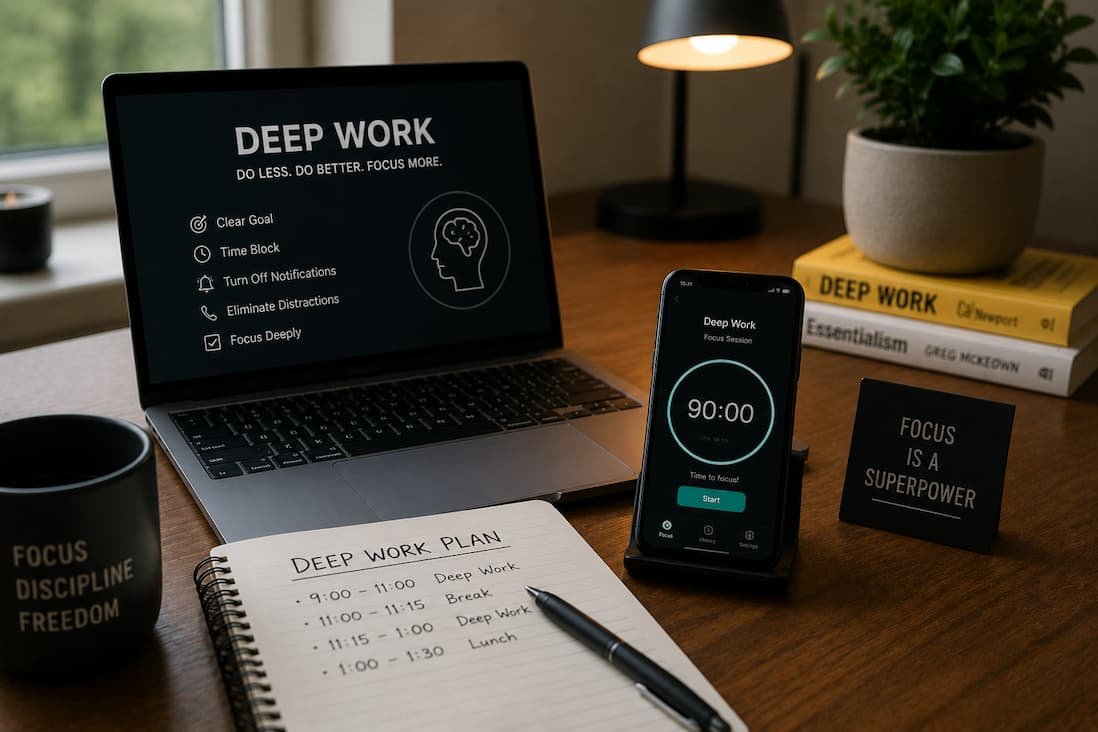
Most people don’t struggle with productivity because they lack motivation. They struggle because their attention is constantly being pulled in different directions. An email arrives while they’re writing a report. A message pops up during a coding session. A quick glance at social media turns into twenty minutes of scrolling. By the end of the day, they have been busy almost every hour, yet the work that truly mattered remains unfinished.
This is where deep work becomes valuable. Deep work isn’t about filling every minute of the day with intense concentration or trying to outwork everyone else. It is about creating uninterrupted periods where your mind can focus on one meaningful task long enough to produce work that requires real thinking. Whether you’re a software developer solving a difficult programming problem, a student preparing for an important examination, a designer working on a creative project, or a business owner planning future growth, the ability to focus deeply has become one of the most valuable professional skills.
However, there is another side to the conversation that often receives less attention. Many people discover deep work, become excited by the concept, and immediately attempt to spend six or seven hours every day in complete concentration. They soon find themselves mentally exhausted, frustrated, and unable to maintain the routine. The problem isn’t deep work itself—it is the unrealistic expectation that the human brain can perform at maximum capacity all day without needing recovery.
Planning deep work sessions effectively means respecting both your ambition and your mental limits. The goal isn’t to squeeze every possible minute out of your schedule. Instead, it’s to create a rhythm that allows you to consistently produce your best work without sacrificing your health, creativity, or enthusiasm.
Deep Work Is About Quality, Not Endurance
One of the biggest misconceptions surrounding productivity is the belief that more hours automatically lead to better results. Many workplaces still reward visible busyness. Someone who answers emails late into the evening or attends back-to-back meetings may appear highly productive, while someone who quietly spends two focused hours solving an important problem might seem less active.
Reality often tells a different story.
Complex work requires concentration rather than constant activity. Writing an insightful article, designing a reliable software system, analyzing financial data, or creating a business strategy cannot usually be done effectively while switching between multiple tasks every few minutes. These kinds of responsibilities demand uninterrupted thinking.
Imagine trying to read a challenging book while someone interrupts you every three minutes. You would spend more time remembering where you left off than actually understanding the material. The same thing happens during knowledge work. Every interruption forces your brain to rebuild context before meaningful progress can continue.
This explains why a focused ninety-minute session can accomplish more than an entire afternoon filled with distractions.
Rather than asking yourself, “How many hours did I work today?” a better question is, “How much important work did I actually finish?” The answer often reveals that quality concentration matters far more than total time spent sitting at a desk.
Why Burnout Happens Even When You Enjoy Your Work
Burnout is commonly associated with jobs people dislike, but that’s only part of the picture. Many passionate professionals experience burnout precisely because they care deeply about their work.
When you’re genuinely interested in what you’re doing, it’s easy to ignore signs of mental fatigue. You convince yourself to work just another hour. Then another. Soon those extra hours become a daily habit.
Initially, productivity seems to improve.
After several weeks, however, small warning signs begin to appear.
You may notice that simple decisions suddenly feel complicated. Reading the same paragraph multiple times becomes common. Creative ideas become harder to generate. You find yourself staring at the screen without making meaningful progress, even though you’re technically “working.”
This gradual decline rarely happens overnight. It develops through repeated cycles of pushing beyond your brain’s natural recovery needs.
Unlike physical fatigue, mental exhaustion is often difficult to recognize until performance has already started to decline. That is why planning deep work sessions must include recovery as an essential component rather than treating it as an optional reward after work is finished.
Understanding Your Personal Focus Pattern
One productivity mistake that many people make is copying someone else’s routine.
You might read about an entrepreneur who wakes up at 4:30 every morning or a writer who works best after midnight. While these stories are interesting, they don’t necessarily provide a blueprint for your own schedule.
Human attention follows natural rhythms, and those rhythms vary from person to person.
Some individuals produce their highest-quality work shortly after waking up, when their minds are fresh and distractions are minimal. Others gradually build momentum during the morning and reach peak concentration before lunch. There are also people whose creativity becomes strongest during quiet evening hours.
Instead of forcing yourself into a schedule that doesn’t match your biology, spend several days observing your own patterns.
Pay attention to questions like these:
- When do difficult tasks feel surprisingly manageable?
- At what time do you solve problems more quickly?
- When do you begin losing concentration naturally?
- Which parts of your day are usually interrupted by meetings, family responsibilities, or notifications?
These observations often reveal that your most productive hours are already present—you simply haven’t been protecting them.
Once you identify those periods, reserve them for work that requires your highest level of thinking. Administrative tasks, routine communication, and organizational work can usually wait until your energy naturally begins to decline.
Choosing the Right Task Matters More Than Choosing the Right Time
Many people carefully schedule deep work but overlook an equally important factor: selecting the right activity.
Not every task deserves uninterrupted concentration.
If your morning’s most valuable mental energy is spent deleting emails, organizing folders, or updating calendars, you’re investing your sharpest thinking in work that doesn’t truly require it.
Instead, identify the tasks that create lasting value.
For a developer, this may involve designing a new application feature or solving a difficult debugging issue.
For a student, it could mean mastering a difficult chapter rather than reviewing material already understood.
For a writer, it might involve producing a first draft instead of formatting completed sections.
The best deep work sessions focus on activities where sustained attention directly improves the final result.
Routine work certainly has its place, but it should rarely occupy the hours when your brain performs at its peak.
Preparing Your Mind Before the Session Begins
Deep work doesn’t usually start the moment you sit down.
Your brain often carries unfinished conversations, pending decisions, and dozens of small reminders from earlier in the day. If you immediately attempt to tackle complex work, these thoughts compete for attention.
Creating a simple transition ritual helps your mind shift into a focused state.
The ritual doesn’t need to be complicated.
Some people begin by clearing unnecessary items from their desk. Others write their objective on a notebook before opening their computer. Some spend two quiet minutes reviewing what they plan to accomplish, while others simply close messaging applications and silence notifications.
The specific routine matters less than its consistency.
Repeated over time, these small actions become signals that tell your brain it’s time to concentrate. Just as athletes develop routines before competitions, knowledge workers benefit from predictable habits that reduce the effort required to enter a focused state.
Eventually, your mind begins associating those rituals with sustained concentration, making it easier to begin meaningful work without unnecessary delay.
The Hidden Cost of Starting Without a Plan
Many deep work sessions lose momentum before they truly begin because the objective isn’t clear.
Imagine sitting down with the intention of “working on a project.” That sounds reasonable, but your brain immediately faces dozens of decisions.
Which file should you open first?
What part needs attention?
Should you research, write, edit, or organize?
Every small decision consumes mental energy before real work has even started.
A much more effective approach is to define a concrete objective before your session begins.
Instead of writing “Work on presentation,” decide that you will complete the introduction and design the first five slides.
Instead of planning to “study programming,” commit to understanding one specific concept and solving several related exercises.
Specific goals reduce hesitation because there is no uncertainty about where to begin.
Interestingly, many experienced professionals spend several minutes planning tomorrow’s first task before ending today’s workday. This simple habit removes uncertainty the following morning and allows deep work to begin almost immediately instead of being delayed by planning.
Why Longer Sessions Aren’t Always Better
When people first discover deep work, they often imagine spending entire days locked away in complete silence.
Although this sounds productive, reality is usually different.
The brain performs exceptionally well during periods of sustained concentration, but maintaining that intensity for six or seven continuous hours is unrealistic for most people. As fatigue accumulates, attention begins to wander. Reading becomes slower. Mistakes increase. Decision-making suffers.
Rather than extending sessions indefinitely, successful professionals often focus on maintaining the quality of their attention.
For someone new to deep work, even sixty to ninety minutes of uninterrupted concentration can produce remarkable results. With experience, some individuals comfortably extend sessions beyond two hours, but they do so gradually instead of forcing themselves into marathon workdays.
The objective should never be to prove how long you can remain seated. The objective is to preserve enough mental clarity that every minute contributes meaningful progress.
When your concentration begins noticeably declining despite genuine effort, it is often a sign that your brain has earned a period of recovery rather than another hour of forced productivity.
Protecting Your Attention Is More Important Than Finding Extra Time
One of the most surprising discoveries people make when they begin practicing deep work is that they don’t necessarily need more hours in the day. What they need is fewer interruptions.
Attention is a limited resource. Every time you stop working to reply to a message, check a notification, or answer an email, your brain doesn’t instantly return to the same level of concentration. It needs time to rebuild the mental context you had before the interruption. If this happens repeatedly throughout the day, the cumulative effect is significant. You may spend eight hours at your desk but only experience a handful of truly productive moments.
This is why protecting your attention deserves as much planning as scheduling your calendar.
Think of your attention as something valuable rather than something that should always be available. During a deep work session, every unnecessary interruption has a cost that isn’t immediately visible. The interruption itself might last only thirty seconds, but regaining your original level of focus can take considerably longer.
Creating boundaries doesn’t mean becoming unavailable all day. It simply means deciding that for a defined period—perhaps ninety minutes—your most important task deserves your complete attention.
Many professionals find it helpful to let colleagues or family members know in advance when they will be unavailable. Others switch their devices to focus mode, silence notifications, or move their phones out of sight altogether. These small adjustments remove the constant temptation to divide attention between meaningful work and countless minor distractions.
Learn to Work With Your Energy Instead of Fighting It
Mental energy changes throughout the day. Trying to ignore those natural fluctuations often leads to frustration.
There are mornings when complex problems seem surprisingly easy to solve. On other days, even routine decisions require extra effort. These variations are completely normal.
Instead of expecting yourself to perform at the same level every hour, organize your work according to the type of thinking each task requires.
A demanding analytical project deserves your highest-energy period. Reviewing documents, responding to emails, or organizing files can usually wait until your concentration naturally begins to decline.
This approach allows you to make better use of your cognitive resources without increasing the number of hours you work.
It also reduces the guilt many people experience when they notice their productivity slowing later in the day. A decline in mental energy isn’t a personal failure—it’s simply part of how the brain functions.
The goal is not to eliminate these natural rhythms but to plan around them intelligently.
The Environment Around You Shapes the Quality of Your Thinking
People often think productivity is entirely about motivation or discipline. While both matter, your surroundings quietly influence your ability to focus every single day.
Imagine trying to complete an important report in a room where conversations never stop, notifications constantly appear on your screen, and unrelated documents are scattered across your desk. Even someone with excellent self-discipline would struggle to maintain deep concentration.
A productive environment doesn’t have to be perfectly silent or minimalist. It simply needs to reduce unnecessary mental friction.
Sometimes this means working with a clean desk because visual clutter competes for attention. Other times it means using noise-canceling headphones, closing browser tabs that aren’t relevant, or choosing a location where interruptions are less frequent.
The objective isn’t to create a perfect workspace that exists only in productivity videos online. The objective is to remove enough distractions that your mind can stay engaged with one task for an extended period.
Even small improvements in your environment often produce surprisingly large improvements in focus.
Why Multitasking Feels Productive but Rarely Is
Many people describe themselves as excellent multitaskers. In reality, what usually happens is rapid task switching.
The brain isn’t performing multiple demanding activities simultaneously. Instead, it jumps back and forth between them, paying a hidden cost every time it changes direction.
Suppose you’re writing an important proposal. Halfway through a paragraph, you check your email because a notification appears. While reading the message, another notification reminds you about tomorrow’s meeting. You open your calendar, adjust an appointment, reply to a quick message, and then return to your proposal.
Although only a few minutes have passed, your thinking has been interrupted several times. Before you can continue writing, your brain must remember the argument you were making, the evidence you planned to include, and the sentence you intended to write next.
This rebuilding process happens so frequently that many people underestimate how much time it consumes over the course of a day.
Deep work reduces this hidden cost by encouraging sustained attention instead of constant switching.
Planning Breaks Before You Need Them
One mistake that frequently leads to burnout is treating breaks as rewards rather than necessities.
People often tell themselves they’ll take a break after finishing “just one more thing.” Unfortunately, there is always one more thing waiting.
By the time they finally step away from their desk, mental fatigue has already accumulated.
A better strategy is to schedule recovery before exhaustion appears.
Short breaks give your brain an opportunity to reset without completely losing momentum. During these moments, it’s helpful to do something that genuinely allows your mind to recover rather than immediately replacing work with another form of stimulation.
Walking for a few minutes, stretching, drinking water, looking outside, or simply resting your eyes from a screen can be surprisingly effective.
What matters is creating enough distance from intense thinking that your attention has a chance to recover.
Ironically, people who regularly take intentional breaks often accomplish more than those who work continuously because they maintain higher-quality concentration throughout the day.
Recovery Is Part of the Work Process
High performers in physically demanding fields understand the importance of recovery. Athletes don’t train at maximum intensity every hour of every day because they know improvement happens during both effort and recovery.
Knowledge work follows similar principles.
Your brain continues organizing information even after you stop working. Many people have experienced solving a difficult problem while taking a shower, walking outside, or driving home. This doesn’t happen by accident. The mind continues processing ideas even when you’re no longer consciously focusing on them.
Ignoring recovery interrupts this natural process.
Adequate sleep, regular movement, balanced nutrition, and time away from screens all contribute to better concentration during future deep work sessions.
Unfortunately, recovery is often viewed as unproductive because it doesn’t create immediate visible output.
In reality, it supports nearly every aspect of high-quality thinking, including creativity, decision-making, learning, and problem-solving.
People who consistently neglect recovery usually notice that each new day requires more effort to achieve the same level of performance they once reached with ease.
Measuring Progress Without Becoming Obsessed With Hours
Many productivity systems encourage tracking how many hours you spend working. While time can provide useful information, it doesn’t always reflect meaningful progress.
Imagine spending five uninterrupted hours researching a topic but never beginning the actual project. Compare that with someone who spends two focused hours producing a complete first draft.
The second person created tangible progress despite working fewer hours.
Instead of evaluating every day by the amount of time spent working, consider asking questions like the following:
| Reflection Question | Why It Matters |
|---|---|
| What meaningful result did I produce today? | Focuses on outcomes instead of activity. |
| Did I protect my scheduled deep work time? | Encourages consistency rather than perfection. |
| What interrupted my concentration? | Helps identify patterns worth changing. |
| What should I improve tomorrow? | Supports continuous learning instead of self-criticism. |
These questions encourage steady improvement without creating unnecessary pressure to work longer simply for the sake of increasing numbers.
Deep work should help you create better results, not become another productivity metric that causes stress.
Building Consistency Instead of Chasing Perfect Days
It’s easy to imagine an ideal schedule where every morning begins with perfect focus, every afternoon remains productive, and every task finishes exactly as planned.
Real life rarely looks that way.
Unexpected meetings appear. Family responsibilities change your schedule. Technical problems interrupt carefully planned sessions. Some days your concentration simply isn’t as strong as usual.
This doesn’t mean your deep work system has failed.
One of the healthiest mindset shifts is recognizing that consistency matters far more than perfection.
Missing one planned session isn’t a problem. Giving up because one session didn’t happen is where progress usually stops.
Successful routines are flexible enough to survive ordinary life.
If your planned two-hour session becomes sixty minutes because of an unexpected interruption, those sixty focused minutes still have value. They move your project forward and reinforce the habit of protecting meaningful work.
Over weeks and months, these consistent efforts accumulate into substantial progress, even if individual days are less than perfect.
The most productive people aren’t those who never experience interruptions. They’re the ones who return to focused work without allowing temporary setbacks to become permanent habits.
Created with AIPRM Prompt “AdSense Safe, Human Detected, Plagiarism-Free”
Recognizing the Early Signs That You’re Pushing Too Hard
Burnout rarely appears overnight. It usually develops gradually, making it easy to ignore until it begins affecting both your work and your personal life.
At first, the signs can be subtle. You may find yourself rereading the same paragraph several times because it doesn’t seem to register. Tasks that once felt straightforward suddenly take much longer than expected. You become impatient with small interruptions, not because they’re more frequent than before, but because your mental reserves are already running low.
Over time, the symptoms become harder to dismiss. Motivation decreases even when you’re working on projects you genuinely enjoy. Creative ideas become less frequent, and solving problems feels more like forcing answers than discovering them. Many people mistake this as laziness or a lack of discipline, when in reality their brain is simply asking for recovery.
Listening to these early warning signs doesn’t mean lowering your standards. It means recognizing that sustainable performance requires balance. Continuing to push through severe mental fatigue often produces lower-quality work while making recovery take much longer.
Creating a Weekly Rhythm Instead of Treating Every Day the Same
Many productivity guides focus heavily on daily routines, but your week deserves just as much attention.
Not every day needs to carry the same workload.
For example, if you know Mondays and Tuesdays are typically your highest-energy days, reserve them for your most demanding projects. Midweek can become a good time for collaboration, research, or reviewing completed work. By Friday, when many people naturally experience lower mental energy, administrative tasks, planning, and organizing future projects often fit more comfortably.
This approach prevents every day from feeling like an endless race.
Here’s an example of how a balanced week might look:
| Day | Primary Focus |
|---|---|
| Monday | Strategic planning and deep creative work |
| Tuesday | Major project development |
| Wednesday | Research, learning, and collaboration |
| Thursday | Implementation and problem-solving |
| Friday | Reviews, documentation, planning, and lighter tasks |
This doesn’t mean every week will follow the schedule perfectly. Deadlines, meetings, and unexpected responsibilities will always require adjustments. However, having a general rhythm helps distribute mental effort more realistically instead of expecting maximum performance every single day.
Ending Your Workday the Right Way
The way you finish today’s work has a surprising impact on tomorrow’s productivity.
Many people close their laptops immediately after completing a task or reaching the end of the workday. While this feels satisfying, it often leaves tomorrow’s priorities undefined. The next morning begins with uncertainty, and valuable focus is lost deciding what to do first.
A better approach is to spend five or ten minutes reviewing your progress before ending the day.
Ask yourself a few simple questions:
- What did I complete today?
- What remains unfinished?
- What should I work on first tomorrow?
- Are there any documents or materials I should prepare now?
Writing these answers down removes much of the mental clutter that follows you into the evening.
Perhaps more importantly, it creates a clear starting point for your next deep work session. Instead of spending twenty minutes figuring out where to begin, you can start almost immediately while your motivation is still fresh.
This small habit also makes it easier to mentally disconnect from work. Once tomorrow’s priorities have been captured, your brain no longer needs to keep reminding you about them throughout the evening.
The Role of Rest Outside Working Hours
Deep work doesn’t begin when you sit at your desk. It begins with how well you’ve recovered from the previous day.
Sleep is one of the most overlooked contributors to sustained concentration. A well-rested brain processes information more efficiently, adapts to new challenges more easily, and makes better decisions under pressure. On the other hand, even mild sleep deprivation can reduce attention span, memory, and problem-solving ability.
Physical activity also plays an important role. You don’t need an intense fitness routine to experience the benefits. A daily walk, light exercise, or regular movement throughout the day improves circulation, reduces stress, and helps prevent the physical discomfort that often accompanies long hours of desk work.
Equally valuable is giving yourself permission to spend time away from work without feeling guilty. Reading for enjoyment, spending time with family, pursuing hobbies, or simply relaxing without constantly checking notifications all contribute to better mental recovery.
Ironically, stepping away from work often helps you return with clearer thinking and renewed creativity.
Technology Should Support Your Focus, Not Control It
Technology makes modern work possible, but it also creates many of the distractions that interrupt deep concentration.
Every application competes for attention. Notifications, recommendation algorithms, breaking news, promotional emails, and instant messages are all designed to encourage engagement.
This doesn’t mean technology is the enemy. It simply means it should be used intentionally.
One practical strategy is to separate the tools required for deep work from those used for communication and entertainment.
During focused sessions, keep only the applications necessary for the current task open. Everything else can wait until your scheduled break.
Many people also benefit from checking email and messaging platforms at specific times rather than responding immediately whenever a notification appears. This simple boundary prevents communication from constantly interrupting meaningful work.
Technology should remain a tool that serves your priorities rather than dictating how your attention is spent.
Deep Work Is a Skill That Improves Through Practice
Some people become discouraged after trying deep work for a few days because maintaining concentration feels difficult.
That’s completely normal.
Attention functions much like any other skill. If you’ve spent years working in short bursts interrupted by notifications, your brain has adapted to that environment. Rebuilding longer periods of sustained concentration takes time.
The good news is that improvement is usually gradual but noticeable.
A sixty-minute session that feels challenging today may become comfortable after several weeks of consistent practice. Eventually, your mind begins settling into focused work more quickly, and distractions become easier to ignore.
Progress doesn’t happen because your brain suddenly changes overnight. It happens because repeated practice strengthens your ability to remain engaged with one meaningful task.
Patience is essential. Trying to force perfect concentration from the beginning often creates frustration, while allowing your focus to develop naturally produces far more sustainable results.
Final Thoughts
Planning deep work sessions without burning out requires a different way of thinking about productivity. Instead of measuring success by the number of hours spent working, it encourages you to focus on the quality of your attention, the importance of your priorities, and the sustainability of your routine.
Deep work isn’t about isolating yourself from the world or filling every hour with intense concentration. It’s about recognizing that meaningful work deserves uninterrupted time, while your brain deserves regular opportunities to recover.
The professionals who consistently produce exceptional results aren’t necessarily the ones who work the longest days. More often, they’re the ones who understand when to focus deeply, when to step away, and how to protect their mental energy over the long term.
If you begin with realistic sessions, reduce unnecessary distractions, match important work to your natural energy levels, and make recovery part of your routine instead of an afterthought, deep work becomes something you can maintain for years rather than weeks.
Ultimately, the goal isn’t simply to get more done. It’s to do your best work consistently while still having the energy to enjoy the rest of your life.
Frequently Asked Questions
How long should a beginner’s deep work session be?
If you’re new to deep work, start with 60 to 90 minutes of uninterrupted focus. This duration is long enough to make meaningful progress without creating unnecessary mental fatigue. As your concentration improves, you can gradually increase the length of your sessions.
Is deep work suitable for every profession?
Deep work is especially valuable for roles that involve problem-solving, analysis, writing, programming, design, research, learning, and strategic planning. Jobs that require constant customer interaction or immediate responses may involve shorter deep work sessions, but the principles can still be applied whenever uninterrupted thinking is needed.
Can deep work reduce stress?
Yes. Many people find that completing meaningful work through focused sessions reduces the stress caused by unfinished tasks, constant multitasking, and last-minute deadlines. However, deep work should always be balanced with regular breaks and healthy recovery habits.
How many deep work sessions should I schedule each day?
For most people, one to three well-planned sessions are more effective than attempting to remain intensely focused throughout the entire workday. The ideal number depends on the complexity of your work, your experience, and your available mental energy.
What should I do if I lose focus during a session?
Brief distractions are normal. Rather than becoming frustrated, gently return your attention to the task. If your concentration continues to decline despite repeated efforts, it may be time for a short break before resuming your work.
What’s the biggest mistake people make with deep work?
One of the most common mistakes is believing that deep work means working continuously for many hours without rest. Sustainable deep work combines focused effort with intentional recovery, allowing you to maintain high-quality thinking over weeks, months, and years instead of exhausting yourself after a short period.

Daniel Kareem is a digital productivity and technology writer focused on simplifying everyday tech use. He creates practical guides on online safety, device optimization, and efficient workflows. His approach centers on clear, step-by-step advice that helps users stay organized, secure, and productive. Through straightforward and realistic content, he aims to make technology easier to understand and more useful in daily life.